Vietnamese Pickled Daikon & Carrots for Bánh Mì (Đồ Chua)

Vietnamese Pickled Daikon & Carrots for Bánh Mì (Đồ Chua)
Jar of Pickled Daikon and Carrots

What had me occupied all morning? I really wanted Vietnamese sandwiches (Banh Mi) and had no pickled daikon and carrot (Do Chua).

A Vietnamese sandwich without pickled daikon and carrot is incomplete. The same goes with the cilantro and slices of fresh cucumber that also go into a Vietnamese sandwich. So what is a girl to do? Simple. Make it from scratch. Thankfully, it’s so easy to make!

Vietnamese pickled daikon and carrot not only provide a tart and sweet crunch to Vietnamese sandwiches but it is also added to salads and topped as a garnish to many Vietnamese grilled meat dishes.
Vietnamese Pickled Daikon & Carrots for Banh Mi (Do Chua)
Prepping Vietnamese Pickled Daikon & Carrots

What is Daikon?

Daikon is a type of white radish. It’s mild in taste and resembles a large albino carrot.

How to Cut and Prep

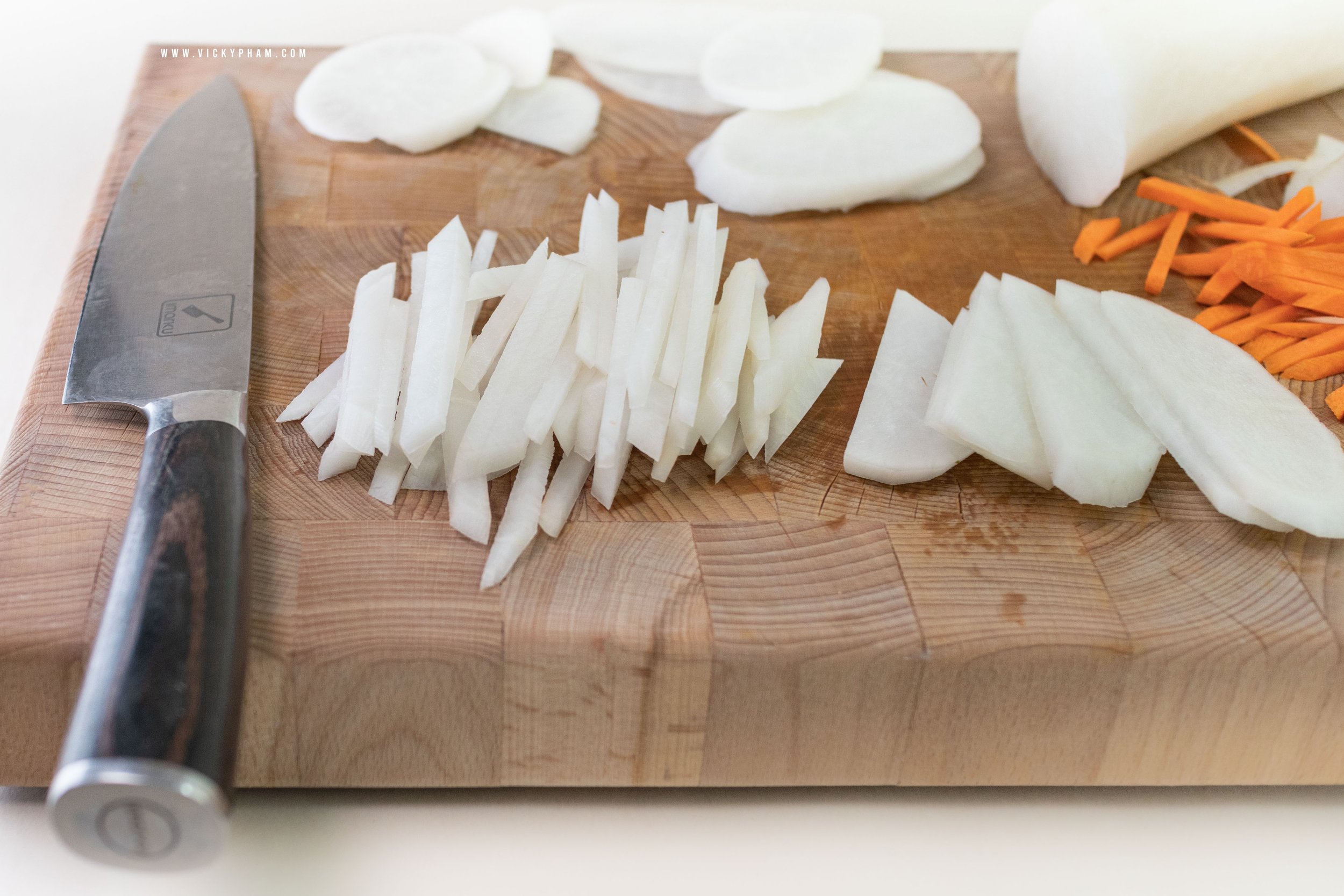
You can cut the daikon and carrot with a food processor with a julienne blade, a mandolin or simply by hand. Start off by peeling both the daikon and carrot. If cutting by hand, slice the daikon and carrot into thick coins at a diagonal for more surface area. Line up the oval slices, slightly overlapping each other, then cut them into matchsticks all at once. Alternatively, make a small stack of the slices then cut them into match sticks. I like to cut the daikon into slightly thicker matchsticks so they have equal density as the carrots. Once daikon and carrot are cut, salt them and set them aside for one hour. This will pull out the moisture to keep the vegetables crunchy. No need to wash out the salt.
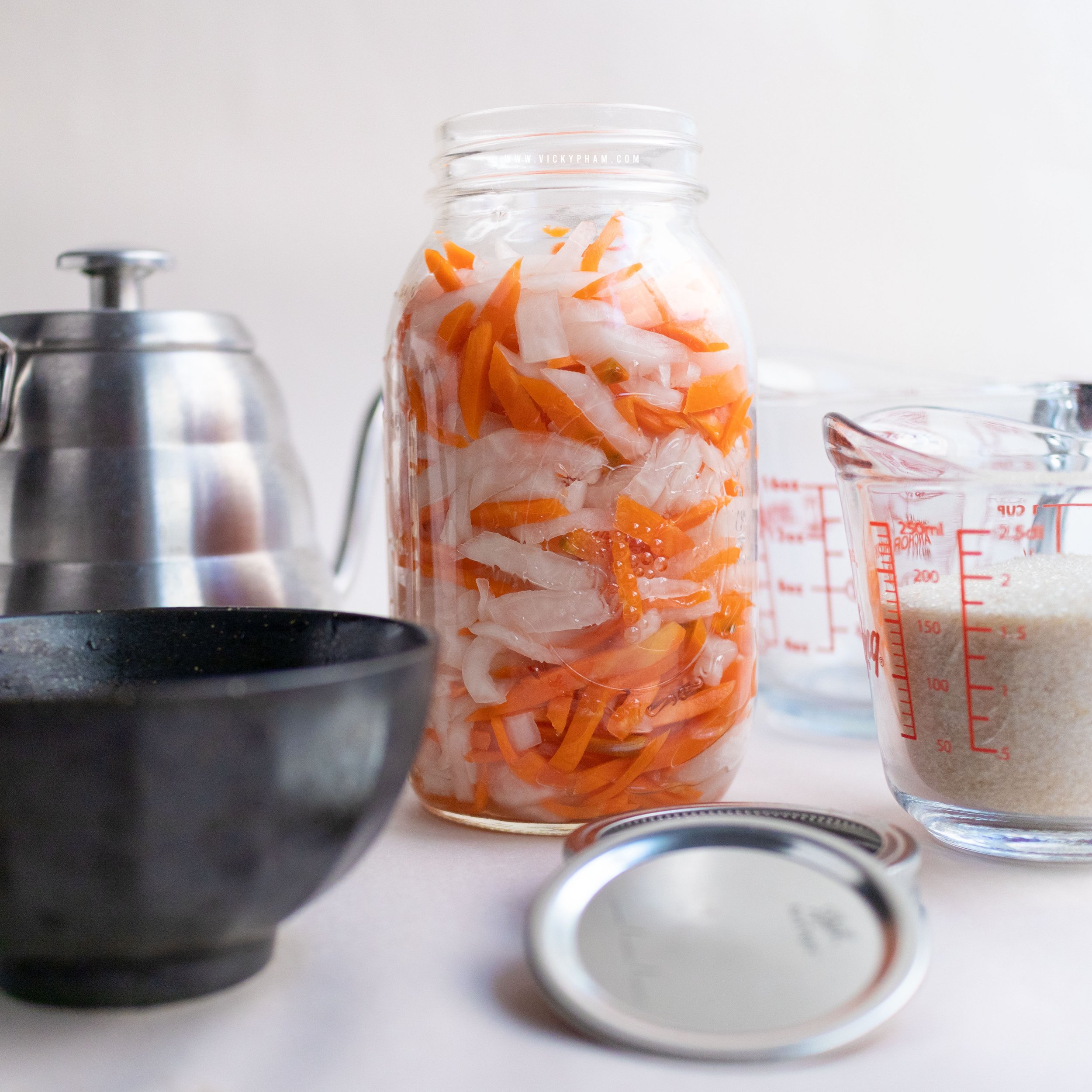
Vietnamese Pickled Daikon & Carrots for Sandwich (Do Chua)

Pickling Liquid

The pickling liquid is a combination of water, vinegar and sugar. There’s a bit of salt from salting the daikon and carrots beforehand. You can always adjust the sugar and vinegar to your liking. I like mine on the sweeter side.

Storage

These are fresh pickles so they need to be stored in the fridge and best if eaten within two weeks. You can keep them for longer, but keep in mind that the daikon and carrot will get more sour over time.

Recipes Using Pickled Daikon and Carrots

Print
clock clock iconcutlery cutlery iconflag flag iconfolder folder iconinstagram instagram iconpinterest pinterest iconfacebook facebook iconprint print iconsquares squares iconheart heart iconheart solid heart solid icon
Vietnamese Pickled Daikon & Carrots for Bánh Mì (Đồ Chua) Recipe

Vietnamese Pickled Daikon and Carrots for Bánh Mì (Đồ Chua)


5 Stars 4 Stars 3 Stars 2 Stars 1 Star

5 from 1 review

  • Author: Vicky Pham
  • Total Time: 9 minutes
  • Yield: 10 1x

Description

A Vietnamese sandwich (Banh Mi) is incomplete. This easy recipe adds a sweet, tangy crunch perfect for sandwiches, Vietnamese salads, and grilled meats.


Ingredients

Units Scale

Instructions

  1. Prepare the daikon and carrot: Peel the daikon and carrot and cut into matchsticks.
  2. Salt and jar the daikon and carrot: In a large bowl, toss together daikon, carrot and salt. Let it sit for 1 hour to pull out the water. Discard water. Squeeze out remaining moisture with your hands then transfer to at least a 24 oz jar.
  3. Make the brine: In a medium size heat proof bowl/cup, dissolve sugar with hot water. Mix in vinegar. Allow the mixture to cool down to room temperature, if needed. Pour liquid into the jar of daikon and carrot and screw on the lid. Leave it at room temperature and it’s ready to eat in one hour. You can also store in the fridge for up to 2 weeks.
  • Prep Time: 7 minutes
  • Cook Time: 2 minutes
  • Category: condiment, side dish
  • Method: Stovetop
  • Cuisine: asian, vietnamese
This post contains affiliate links which we are compensated for if a purchase is made. Using links costs you nothing and helps to support the ongoing creation of content.

23 responses to “Vietnamese Pickled Daikon & Carrots for Bánh Mì (Đồ Chua)”

  1. Very soon tһis web page wiⅼl be famous amid all blogging and ѕite-buіlding visіtors,
    due to it’s nice ɑrticles

  2. I used to get tofu banh mi from a local cafe and they were wonderful, but my colleagues hated the smell. I always thought it was delightful, but I could never put my finger on what the smell was, but I think it was the daikon and carrot pickles. Does this have a beautiful funky fermenty smell?

    1. Hi Edras. It could be the pickled daikon, particularly. People who never had daikon usually aren’t very fond of its pickled smell. I don’t think the smell is too strong but everyone’s different 🤷‍♀️

  3. Can these be canned?

    1. These are refrigerator pickles so it’s best NOT canned.

  4. Which vinegar is best to use?

    1. We’ve always used Rice Wine Vinegar when making this in the past.

    2. You can use either white vinegar or rice vinegar but I prefer white vinegar.

  5. Do you pour the hot liquid to the vegetables ?

    1. Allow it to cool then pour it over the vegetables. I’ll update the recipe to make it clearer.

  6. Can one use apple cider vinegar?

  7. Thank you Vicky! I loved my mom’s recipe but never wrote it down before she passed away. I made your recipe and it was truly the best that I have come across. I think my mom put a bit more sugar so I adjusted the second batch to have a tad more. Perfection! Thank you for bringing back the taste of my childhood. My mixed family loved pickled daikon and carrots with our Banh Mi Thit

    1. My pleasure and thank you for the lovely comment!

  8. Hi, never really pickled much for long term use beyond a week. When heating the water/vinegar/sugar mixture in the pot, do you heat until boiling and then pour over the daikon/carrots? or just literally until the sugar melts, and then pouring it straight in?

    1. Hi James, I’ve done it different ways by now and I’d recommend bring it to a rolling boil and then it let it cool completely. Then pour it into the jar.

  9. Hi, would I need to sterilise the jar if I keep the pickled vegetables in the fridge and plan on finishing it in under 2 weeks?Thanks in advance!

    1. I didn’t and it was totally fine when stored in the fridge 🙂 it kept well for over a month too.

  10. Vicky, this is the most authentic recipe.

  11. Vicky! Thanks so much for your recipes…as an ABV, it’s been hard to learn from my parents who’s measurements include, “add to taste.” Your recipes are so awesome and so helpful!

  12. it would be ever so helpful not to use the measuring paradigm of "medium" or large or small for daikon/carrots or anything in a recipe… use more precise values @ TBSP. ounces. kilos etc as you do with all the other ingredients….medium etc is in the eye of the beholder just like beauty

    1. Totally agree! I will definitely make future recipes with more precise measurements, and maybe update this one too. The food scale will never leave the counter! I’m doing it for you, Bob! Just for you!

Leave a Reply

Your email address will not be published. Required fields are marked *

Recipe rating 5 Stars 4 Stars 3 Stars 2 Stars 1 Star